Stop treating summer like downtime. It’s one of the year’s strongest intent signals.
As the weather warms up, budgets begin shifting toward Back to School, Black Friday, and the holiday season. Summer becomes the period in between, often viewed as a time when consumers are away, attention is fragmented, and meaningful demand slows.
The reality is quite different.
Across Europe, consumers are actively researching, comparing, and preparing for purchases. Today, 82% of European households are looking for discounts, while promotions now account for nearly 22% of FMCG revenue in France. Travel demand is also reaching new highs, with 39% of Europeans planning a trip between April and September 2026, the strongest summer outlook since 2020. At the same time, nearly half of consumers say they are comparing prices more carefully than ever, and 38% have already reduced spending in specific categories.
Taken together, these aren’t signs of a market slowing down. They point to consumers becoming more deliberate about how, when, and where they spend. Purchase decisions are already taking shape well before the traditional retail peaks arrive. The brands that recognize those signals first have an opportunity to engage consumers before competition intensifies heading into the second half of the year.
Across Dailymotion’s premium video ecosystem, those early shifts in behavior are already visible. Consumption of summer-related content across retail, travel, beauty, food, and deals grew 43% year over year in 2025, with another 40% increase projected for 2026. More than 190 million moments of consumer intent were identified in August 2025 alone, underscoring that summer is far from a seasonal lull. It’s one of the earliest periods where purchase intent accelerates across categories.
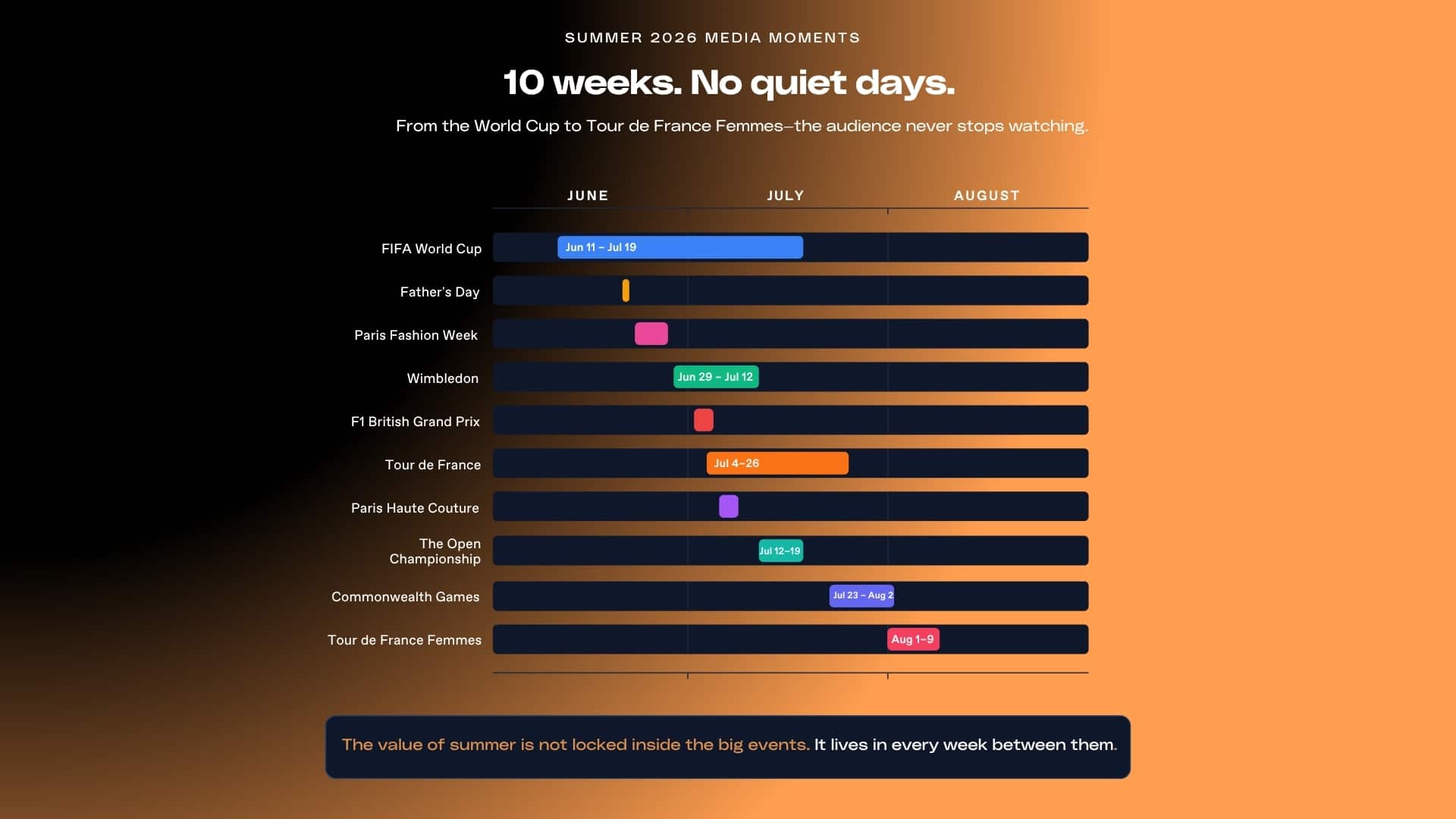
Summer isn’t one event, it’s ten weeks of uninterrupted attention.
One reason summer continues to be underestimated is that marketers tend to think about it as a series of isolated tentpole moments. The World Cup. Wimbledon. The Tour de France. Paris Fashion Week. Formula 1. Each event earns its own marketing plan, media budget, and creative strategy.
Consumers don’t experience summer that way.
From June through August, audiences move seamlessly between sports, travel, entertainment, shopping, and lifestyle content. One week they’re following the World Cup. The next they’re researching travel destinations, watching tennis highlights, exploring beauty trends, or planning Back to School purchases. Rather than isolated spikes, these moments create ten consecutive weeks of sustained attention across premium video environments.
The opportunity isn’t simply showing up during one major event. It’s understanding how audiences move between all of them. Brands that plan around isolated moments risk missing the broader behavioral journey unfolding between them.
Consumer intent appears long before purchase.
By the time someone searches for a product or adds it to their cart, much of the decision-making process has already begun. Across Dailymotion’s ecosystem, search activity consistently increases more than 30% during the summer compared with the previous quarter. Consumers aren’t just watching more video. They’re actively exploring interests, researching purchases, and discovering brands while intent is still forming.
This is where first-party video intelligence provides a different perspective. Rather than relying on inferred audiences or historical browsing behavior, Dailymotion observes how people engage with premium video content in real time. What they’re watching, which topics they’re exploring, how those interests evolve, and where engagement begins to accelerate all provide valuable signals about future purchase behavior.
Viewed individually, these actions may appear unrelated. Someone researching travel may soon begin watching luggage reviews. A cycling fan following the Tour de France may start exploring outdoor equipment. Parents watching family entertainment naturally begin shifting toward Back to School content. Viewed together, these behaviors reveal something much more valuable: where consumers are headed next.
Following audiences instead of campaigns
Most media plans are still built around campaigns. Consumers aren’t. They move fluidly between content, devices, and interests throughout the day, often discovering new products long before they make a purchase. Understanding those transitions is becoming one of the biggest competitive advantages in modern advertising.
Dailymotion helps solve this. Rather than treating every impression as an isolated interaction, it helps marketers understand how audiences naturally progress across content, screens, and moments, allowing brands to engage consumers while decisions are still taking shape instead of after intent has become obvious.
Turning signals into outcomes
Understanding consumer behavior only matters if it improves campaign performance.
Powered by Ray, Dailymotion’s audience intelligence engine analyzes first-party viewing signals across more than 5,000 premium publisher environments to identify purchase intent, content affinities, demographic characteristics, and contextual signals as they emerge. Those insights can then be activated across CTV, mobile, and online video through Pulse, enabling brands to reach audiences when attention and intent naturally converge.
The same intelligence also helps improve creative effectiveness before campaigns launch. Every asset is evaluated across attention, emotion, memory, and cognitive demand, helping ensure creative is optimized before the first impression is served.
The result is measurable business impact. Across campaigns measured by Happydemics, Dailymotion delivers an average +10-point brand lift, double the industry benchmark, alongside a 1.5% click-through rate compared with an industry average of 0.5%.
Summer belongs to brands that recognize demand early
Perhaps the biggest misconception about summer is that it’s simply the period before the “real” shopping season begins.
In reality, it’s when consumer demand begins taking shape.
Competition is often lighter than during Q4, while audiences remain deeply engaged across sports, entertainment, travel, retail, and lifestyle content. For brands willing to look beyond the traditional retail calendar, summer offers something increasingly rare: a sustained period where attention, cultural relevance, and purchase intent rise together.
The brands that capitalize on this opportunity won’t necessarily be the ones spending the most. They’ll be the ones that recognize demand sooner, understand how audiences naturally move across content and screens, and engage consumers while decisions are still being made.
Summer isn’t the pause before the year’s biggest opportunities.
It’s where many of them begin.